Trust wallet app is a self-custody wallet for swaps, staking, and Web3 access
Self-custody multi-chain crypto wallet for storing assets, swapping tokens in-app, and staking coins for network rewards.
Trust wallet app is a mobile and browser wallet for holding crypto directly, swapping tokens inside the interface, staking supported coins for network rewards, and connecting to Web3 applications. It gives the user control of private keys through a recovery phrase while supporting many chains, NFTs, DeFi apps, and newer features such as SWIFT smart contract wallets.
The main reason people search for it is convenience: one wallet interface covers Bitcoin, Ethereum, BNB Smart Chain, Solana, Polygon, Tron, Cosmos-based assets, and many token standards used across DeFi. The Trust wallet app keeps the everyday actions close together, so a user checks balances, sends funds, receives assets, signs transactions, and reviews market prices without moving between several separate tools.
In-app swaps connect wallet balances to on-chain liquidity
Swapping inside the wallet means the user chooses a token to sell, chooses a token to receive, reviews the quoted amount, and signs the transaction from the wallet. The trade still settles through blockchain rails, so network fees, token approvals, slippage settings, and route quality matter. A swap from BNB to a BEP-20 token behaves differently from an Ethereum ERC-20 trade because each network has its own gas token and confirmation pattern.
This workflow suits people who already hold assets and want to rebalance without first transferring to a centralized exchange. The quote screen deserves attention because the visible exchange rate is only part of the transaction. A congested chain raises gas costs, a thin liquidity pool worsens execution, and a token with unusual transfer rules creates a different final amount than a simple blue-chip asset such as ETH, BTC, SOL, or BNB.
Staking turns supported coins into network participation
Trust wallet app includes staking for supported proof-of-stake assets, which means the wallet delegates coins to validators where the chain design allows delegation. Rewards come from the network rules of the asset, not from the wallet balance screen itself. Coins such as BNB, TRX, ATOM, and other supported staking assets follow their own unbonding periods, validator choices, reward timing, and minimum requirements.
Staking works best when the user understands three practical details before signing: the asset being delegated, the validator receiving the delegation, and the time needed to unstake or withdraw rewards. A higher displayed reward rate loses value when the validator performs poorly or when an unbonding period traps funds during a market move. The wallet makes the action easier to start, while the chain determines the mechanics.
Self-custody starts with the recovery phrase
The recovery phrase is the master backup for a standard wallet account. Whoever controls it controls the assets tied to that wallet, so it belongs offline, written accurately, and separated from screenshots, cloud notes, email drafts, and chat messages. Trust wallet app relies on that self-custody model: the device signs transactions locally, and the user remains responsible for restoring access if the phone is lost or replaced.
That design gives direct ownership of tokens and NFTs, but it also makes transaction review important. A fake support message, a copied phishing page, or a malicious smart contract approval drains assets after the user signs the wrong request. The strongest habit is simple and specific: read the token, chain, spending permission, and receiving address before approving anything that moves value or grants allowance.
SWIFT smart contract wallets add an account-abstraction option
SWIFT is Trust Wallet's smart contract wallet approach for account abstraction. It changes the account model from a traditional seed-only externally owned account toward a programmable wallet experience with features built around easier Web3 use. The goal is to reduce friction in tasks such as signing, recovery flows, and application interaction while keeping the experience inside a familiar wallet interface.
This matters because crypto wallets have long exposed technical details at the worst moment: gas tokens, approvals, chain switching, and confusing signature prompts. A smart contract wallet design gives developers more room to shape safer, smoother flows. It does not erase the need to understand what a transaction does, but it gives the wallet more tools than a basic address and private key pair.
NFTs, RWAs, and dApps share the same signing layer
NFT storage inside the wallet is less about hiding a picture in an app and more about tracking tokens that live on chains such as Ethereum, BNB Smart Chain, Polygon, or Solana. The wallet displays collectible metadata, sends NFTs, and connects to marketplaces or games through signing requests. The same signing layer also supports DeFi protocols, tokenized real-world assets, and other Web3 applications.
On a practical level, Trust wallet app therefore becomes an access point, not just a balance viewer. A user opens a dApp browser or extension connection, chooses an account, and signs only the requests needed for that session. The wallet interaction confirms identity and permission; the external application provides the market, game, lending pool, prediction contract, or collectible action.
Buying crypto inside the app is an on-ramp, not the whole journey
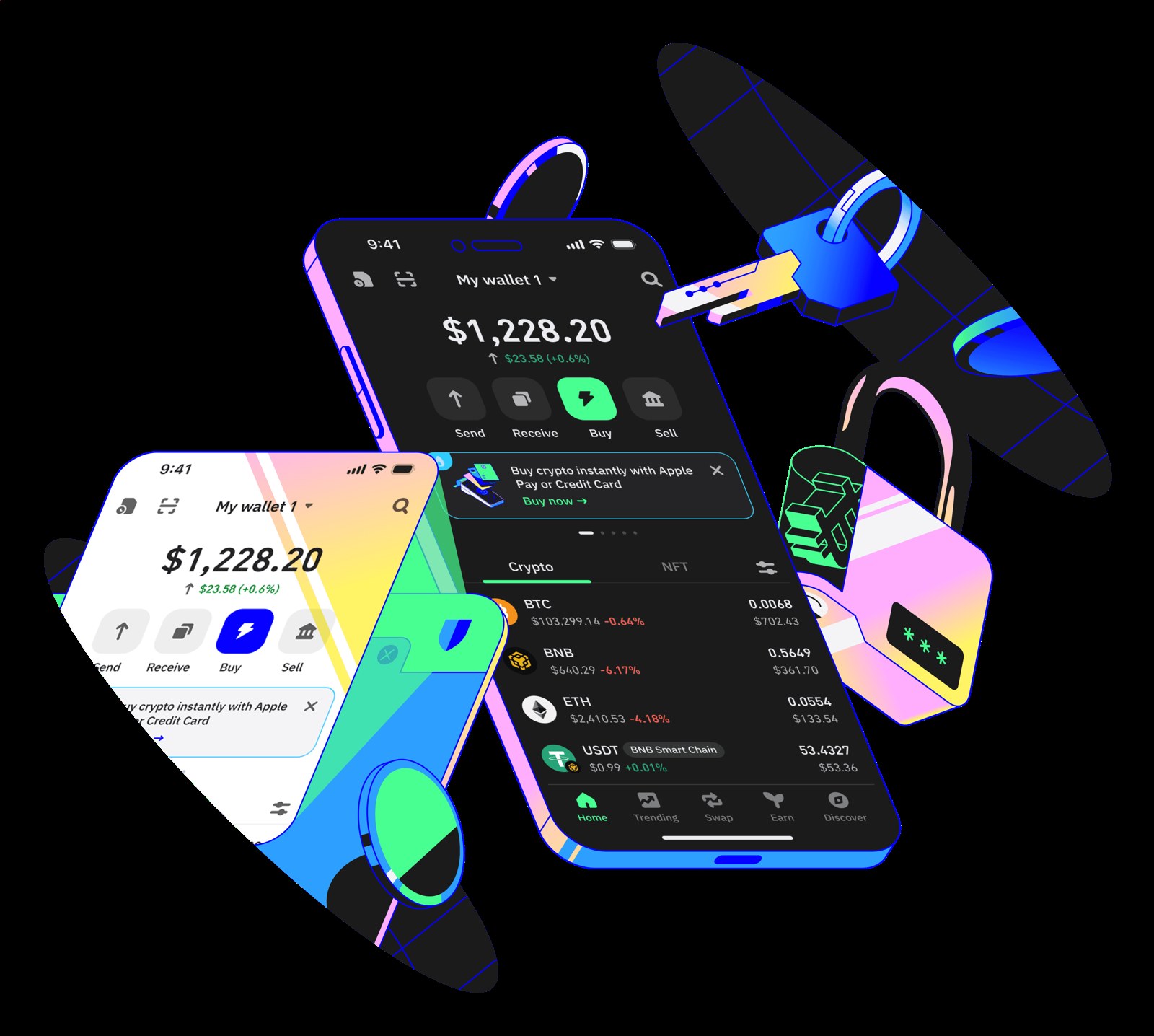
The buy flow is designed for people who need an entry point from traditional payment methods into crypto. The wallet presents purchase options through integrated providers, then the purchased asset arrives in the user's address after the provider and network process the transaction. Identity checks, payment methods, supported regions, minimum purchase sizes, and fees belong to the payment route selected during checkout.
Once funds arrive, the next decision is chain hygiene. USDT on Tron, USDT on Ethereum, and USDT on BNB Smart Chain are different assets on different networks even when the ticker looks the same. Sending a token to an address on the wrong chain creates a recovery problem that a wallet interface cannot always solve. Matching the network before receiving or withdrawing prevents the most common beginner mistake.
Mobile app and browser extension serve different habits
The mobile wallet fits daily balance checks, QR-code payments, quick sends, staking reviews, and simple swaps. The browser extension is better for desktop DeFi, NFT marketplaces, analytics dashboards, and applications that expect a wallet pop-up in the browser. Using both versions gives the same broader Trust Wallet ecosystem two different surfaces: pocket-first on iOS and Android, and workflow-first on desktop.
Neither surface changes the underlying idea of self-custody. The account signs messages and transactions, the chain records the result, and the visible wallet balance updates after indexers and network confirmations catch up. When an incoming transfer appears on a block explorer before the app display updates, the chain record is the useful source of truth while the interface refreshes its token list or network data.

Where Trust Wallet differs from exchange accounts and niche wallets
That said, Trust wallet app is broad by design. MetaMask remains deeply associated with Ethereum and EVM networks, Phantom is especially strong for Solana users, Ledger Live pairs with Ledger hardware devices, and Coinbase Wallet connects a self-custody wallet experience with a familiar exchange brand. Trust Wallet's distinction is its wide multi-chain coverage, mobile-first history, staking access, swaps, NFT support, and expanding Web3 feature set in one consumer wallet.
That breadth is useful for people who hold assets across several networks, but specialization still matters. A Solana-only trader values Phantom's ecosystem focus; a hardware-first holder values Ledger's offline key storage; an Ethereum power user values MetaMask's developer familiarity. Trust wallet app fits users who want a single everyday wallet for many chains without giving up direct custody of their assets.
A practical first setup for swaps and staking
Start by installing the wallet from the official marketplace for the device, create a new wallet, and write the recovery phrase exactly in the shown order. Add only the networks and tokens you expect to use, then send a small test amount before moving larger balances. That first test proves the address, chain, and token standard match.
- Keep the recovery phrase offline and separate from the device.
- Hold the native gas token for each chain you use, such as ETH, BNB, SOL, TRX, or POL.
- Review token approvals before swapping unfamiliar assets.
- Check unstaking periods before delegating coins.
- Use a small transfer when testing a new chain or address.
After that setup, the wallet becomes a practical command center for routine Web3 activity. Trust wallet app handles the visible experience, while the chains themselves enforce balances, fees, transaction finality, staking rules, and smart contract outcomes.
Trust wallet app - common questions
- Fees on Trust wallet app swaps, what should I expect?
- Swap costs include the network gas fee plus any spread or route cost built into the quoted trade. Ethereum swaps use ETH for gas, BNB Smart Chain swaps use BNB, Solana swaps use SOL, Tron swaps use TRX, and Polygon swaps use POL. The final amount changes when liquidity is thin, slippage is wide, or the network is congested.
- Can I stake stablecoins in Trust wallet app for rewards?
- Staking in the wallet is for supported proof-of-stake coins, not ordinary stablecoin balances such as USDT or USDC. Stablecoins used in DeFi lending or yield contracts involve separate smart contract risk and are not the same as delegating a network asset to a validator. Check the asset's own staking screen before assuming it earns rewards.
- How long does a Trust wallet app transfer take to show up?
- A transfer shows after the sending transaction confirms on its blockchain and the wallet interface refreshes that token's balance. Fast chains display within seconds or minutes, while congested networks take longer. If the transaction hash shows the correct receiving address and chain, the on-chain record matters more than a delayed app balance display.
- Recovering access if my phone with the wallet is lost
- Access is restored by installing the wallet on a new device and importing the correct recovery phrase in the exact order. A lost phone does not remove assets from the blockchain; the phrase controls the accounts that hold them. If the phrase is missing, the wallet cannot reconstruct the private keys needed to sign transactions.